
Criminal Court Records in Scotland County
A criminal court record is the case-level file maintained by the Scotland County Circuit Clerk after a criminal matter reaches court. It is different from an arrest report, jail booking record, or statewide criminal-history check. The court file can include the charging document, probable-cause statement when public, warrant or summons, bond orders, arraignment entries, plea events, motions, continuances, trial settings, disposition, sentence, probation orders, restitution, fines, costs, and later compliance or review events.
Scotland County criminal cases are handled through Missouri's Circuit Court system. The Circuit Court may hear felony cases, misdemeanors, criminal traffic matters, preliminary proceedings, probation reviews, and failure-to-appear or warrant events. Associate circuit functions can include misdemeanor matters, preliminary felony events, traffic offenses, and other statutorily assigned work. Municipal division cases, such as city ordinance or municipal traffic matters, may also appear in Case.net when integrated. The local records office is the Scotland County Circuit Clerk.
For the earlier arrest-to-charge pathway, see Scotland County arrest records and court charges. For a broader court-record search across civil, probate, family, traffic, and judgments, use Scotland County court records. Local custody status is a separate sheriff or jail question and belongs with Scotland County inmate records.
How to Search Scotland County Criminal Court Records
The main search channel is Missouri Case.net. Search by defendant name when the case number is unknown, by case number when a summons, citation, warrant, attorney document, or docket sheet provides one, by filing date for recent cases, or by scheduled hearings for upcoming arraignments, reviews, trials, or sentencing settings. Use Scotland County or 1st Judicial Circuit filters when available to avoid unrelated statewide matches.
- Open Case.net and select Case Number, Litigant Name, Filing Date, or Scheduled Hearings.
- Search the defendant's last name or the exact case number. Add first name, middle name, case type, county, or date range to narrow results.
- Open the matching criminal case and review the case header, parties, prosecutor, charge lines, docket entries, hearings, bond, warrant events, and disposition.
- Read each count separately because one case may include multiple charges with different pleas, amendments, dismissals, or sentences.
- Contact the Scotland County Circuit Clerk at (660) 465-8605 for certified copies, older files, courthouse-only documents, or records not displayed online.
A criminal-history search is not the same as a Scotland County criminal court file. The Missouri State Highway Patrol provides name-based criminal record checks through MACHS, described on the MSHP criminal record check page. Research found the name-based search fee listed as $15 plus a convenience fee. MACHS can show broader Missouri criminal-history information, while Case.net and the Circuit Clerk show the court's case record.
The manifest image below comes from the MSHP criminal record check and MACHS information page.
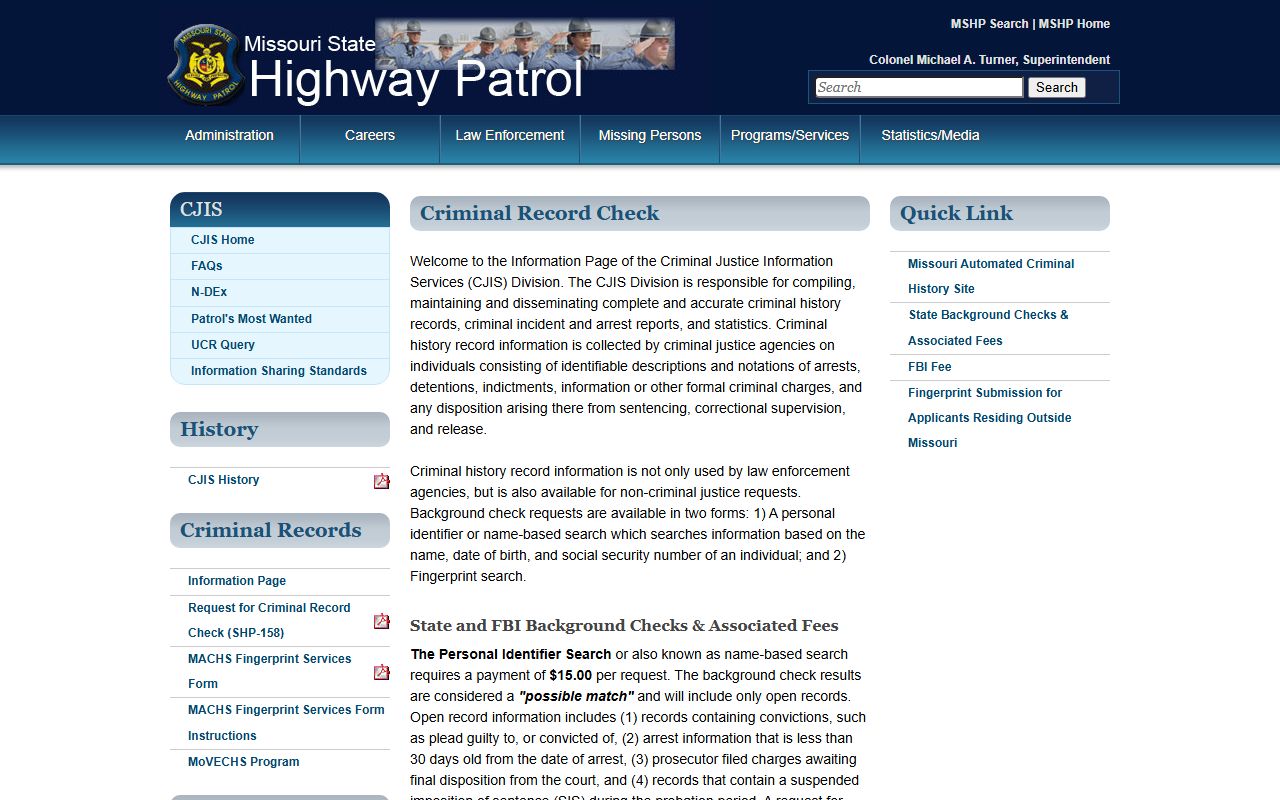
That statewide search can be useful background context, but a person needing a filed charge, court date, plea, disposition, sentence, or certified court copy should still use Case.net and the Scotland County Circuit Clerk.
Stages of a Criminal Case
A Scotland County criminal case generally moves from filed charge to first appearance, pretrial activity, plea or trial, disposition, and sentencing. The docket can also show bond review, warrant events, continuances, probation review, restitution, costs, and compliance matters. The court record begins with a formal court filing, not merely an arrest. A person can be arrested without a filed case, and the prosecutor can file charges that differ from the initial arrest allegation.
Case flow: Charges Filed › Arraignment › Pretrial / Motions › Plea or Trial › Disposition › Sentencing
| Stage | What Happens |
|---|---|
| Charges Filed | The Prosecuting Attorney or charging authority files a complaint, information, indictment, or citation that opens the court-facing case. |
| Arraignment | The defendant appears, charges are addressed, counsel status may be discussed, and a plea or future setting may be entered. |
| Pretrial / Motions | The docket may show discovery, motions, continuances, bond review, warrant entries, suppression issues, or trial settings. |
| Plea or Trial | The case may resolve by guilty plea, dismissal, nolle prosequi, acquittal, conviction after trial, or amended count-level outcome. |
| Sentencing | The court may enter jail, prison, probation, suspended sentence, fines, costs, restitution, treatment, or review terms. |
What a Scotland County Criminal Court Record Shows
Criminal court records combine identifying case information with count-level criminal information. A public Case.net result may show the defendant, the State of Missouri as prosecuting party, prosecutor, attorney, charge text, statute, offense date, severity, bond, plea, docket entries, hearings, warrant activity, disposition, sentence, costs, fines, restitution, and probation data. Some documents may be public but not remotely available. Other material may be confidential, redacted, sealed, expunged, or available only at the courthouse.
| Field | What It Shows |
|---|---|
| Case Number | The Missouri case identifier used in Case.net, clerk records, attorney filings, and copy requests. |
| Defendant | The person charged, with attorney information if public and entered. |
| Charges | Charge language, statute reference, offense date, class or severity, count number, and amendments when entered. |
| Bond / Warrant | Release conditions, bond amount or type, failure-to-appear entries, bench warrants, recalls, or related docket activity. |
| Plea | The defendant's response to a count, such as guilty, not guilty, or other plea-related entry. |
| Disposition | The count-level outcome, such as guilty plea, conviction, acquittal, dismissal, nolle prosequi, or judgment. |
| Sentence | Jail, prison, probation, suspended imposition or execution of sentence, fine, costs, restitution, conditions, or review settings. |
Charges vs. Convictions
A filed charge is an accusation in court. It is not a conviction. A criminal record can show counts that are pending, amended, reduced, dismissed, disposed by plea, resolved by trial, or ended by acquittal. Read the disposition and sentence lines before treating a record as a final outcome. When the same case has several counts, each count may have a different status.
| Charge | Conviction | |
|---|---|---|
| Stage | Accusation filed with the court | Final result after plea, verdict, or judgment |
| Proof Standard | Based on probable cause or charging decision | Requires guilty plea, finding, verdict, or qualifying judgment |
| Public Record | Often public unless sealed, juvenile, expunged, or restricted | Often public unless sealed, expunged, juvenile, or otherwise restricted |
| Practical Use | Shows what was alleged and how the case started | Shows the final court outcome and sentencing consequences |
Reading Dispositions and Sentences
Disposition language should be read carefully. A dismissal without prejudice may leave room for refiling if the law allows it, while dismissal with prejudice generally ends that count. Nolle prosequi means the prosecutor has declined to proceed on that count. A guilty plea or guilty finding may be followed by sentence details, probation, suspended imposition of sentence, suspended execution of sentence, restitution, costs, or a review hearing. A warrant entry may show a missed appearance rather than a conviction.
Sentencing entries can also connect to custody records, but they are not the same thing as current jail or prison housing. A local arrest or jail question goes through the Scotland County Sheriff's Office. A state-prison, probation, or parole inquiry goes through Missouri DOC Offender Search. A federal sentence goes through federal records and the Bureau of Prisons, not the Scotland County Circuit Clerk.
Sealed vs. Expunged Records
Missouri uses several access limits that can affect criminal court records. A sealed case or sealed document is closed from public view by statute or court order. An expungement under Missouri law restricts public access and disclosure for eligible records, but it does not mean every record was physically destroyed. Juvenile criminal-related records are handled under separate confidentiality rules.
| Sealed | Expunged | |
|---|---|---|
| Visibility | Hidden or limited by court order, statute, or security setting | Public-facing access and disclosure restricted after a granted petition |
| Law Enforcement | May retain limited or authorized access depending on the order and law | Access may remain for specified agencies or purposes under Missouri law |
| Eligibility | Depends on case type, statute, order, and confidential content | Governed mainly by RSMo 610.140 for many criminal records, with exclusions and waiting periods |
The manifest image below comes from RSMo 610.140, Missouri's criminal expungement statute.
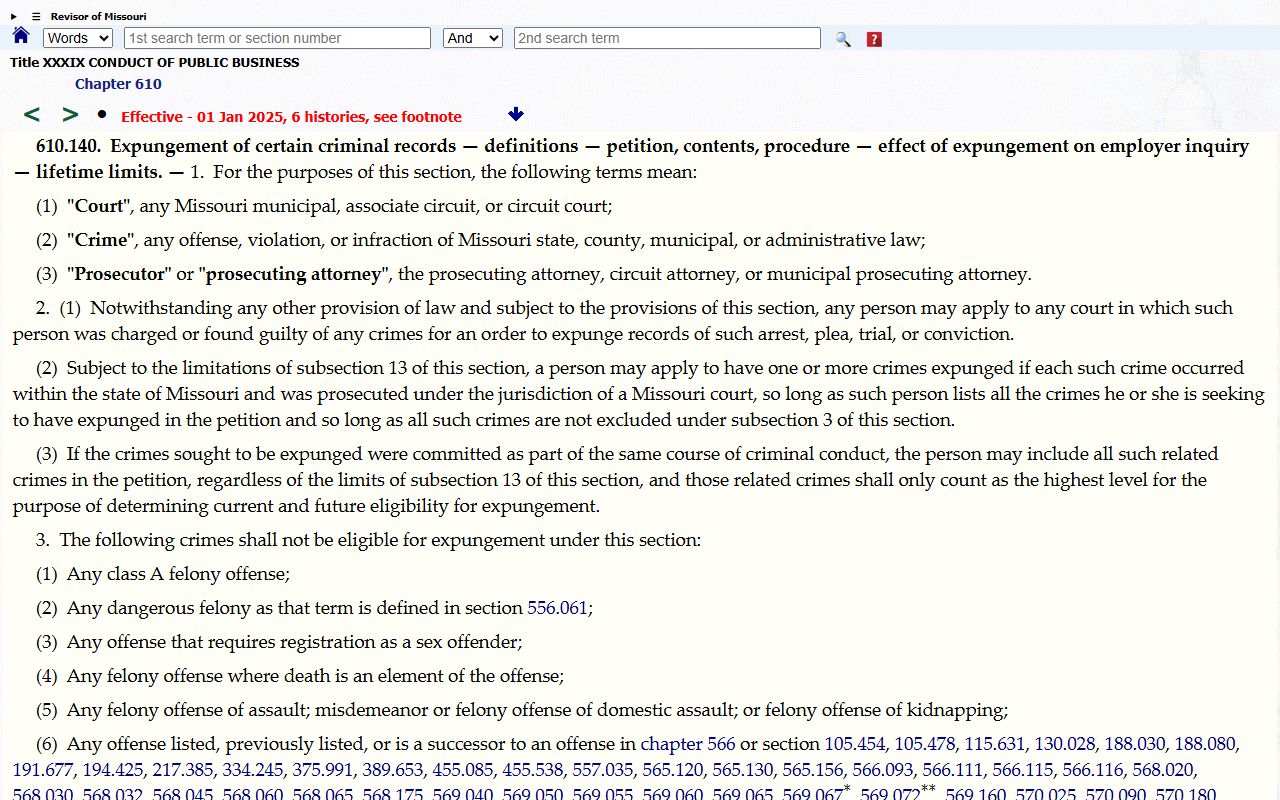
Scotland County petition filing and procedural questions start with the Circuit Clerk, but eligibility questions should be directed to an attorney or legal aid because clerks cannot provide legal advice.
Public Access to Criminal Court Records
Missouri's public-records framework includes Chapter 610, the Sunshine Law, but criminal court records also follow Missouri court-access rules, case security settings, redaction requirements, and court orders. The correct local court-record custodian is the Scotland County Circuit Clerk. Arrest reports, incident reports, and jail records are separate Sheriff records, and statewide criminal history is a Missouri State Highway Patrol channel.
Key Statutes:
RSMo 610.140 - allows eligible people to petition Missouri courts to expunge certain criminal records, with exclusions and waiting periods.
RSMo 211.321 - makes juvenile court and related peace-officer juvenile records confidential except by court order or statutory exception.
The manifest image below comes from Missouri statutes covering arrest, examination, commitment, warrants, and bail.
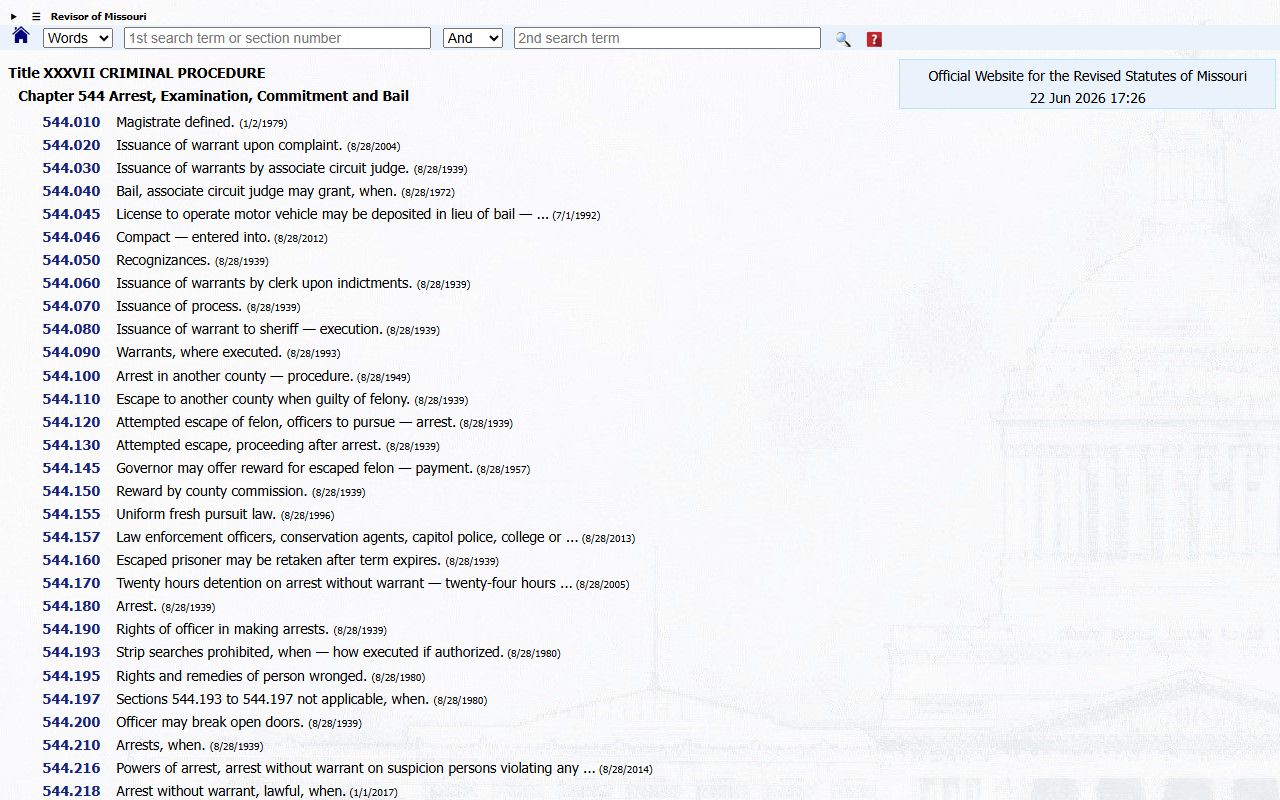
Those statutes help explain why a criminal docket can include arrest warrants, summonses, bond, commitment, or failure-to-appear events, but the docket should still be verified through Case.net or the Circuit Clerk for the current Scotland County case status.
Background Check Considerations
A casual court-record lookup is not the same as a compliant employment, tenant, insurance, credit, licensing, or other consumer-report background check. Case.net and clerk records can help a member of the public understand a specific court case, but regulated background screening has separate legal requirements. For broader Missouri criminal-history checks, use MSHP/MACHS or another legally appropriate channel.
Important: Information from this site may not be used for FCRA-regulated decisions such as employment, tenant screening, credit, or insurance.
Restricted Criminal Court Records in Scotland County
Restricted criminal court records may include juvenile matters, sealed cases, expunged records, sealed search-warrant materials, protected addresses, confidential informant or victim information, medical records, full financial identifiers, Social Security numbers, and documents closed by a judge. Case.net may show limited information or no public result depending on the security setting. If a record is missing, the safest next step is to ask the Scotland County Circuit Clerk whether the file is older, paper-only, sealed, expunged, juvenile, or otherwise restricted.
The Prosecuting Attorney is also relevant to criminal cases. Scotland County's official elected-officials page lists Prosecuting Attorney David Briggs at 117 S. Market Street, Suite 205, Memphis, MO 63555, phone (660) 465-2010. The Missouri State Public Defender office locator lists Kirksville as serving Adair, Knox, Schuyler, and Scotland counties. The Public Defender represents eligible defendants and is not a public records custodian.